

|
Tight Blood Pressure Control Both Healthy And Cost-Effective, Projections Say
By Dennis Thompson WEDNESDAY, Aug. 20, 2025 (HealthDay News) — Tight control over blood pressure is not only good for patients, but is also cost-effective health care, a new study says. Controlling blood pressure to below 120 systolic prevents more heart attacks, strokes, cases of heart failure and other heart-related health problems, compared with higher targets, researchers report in the Annals of Internal Medicine. It’s also cost-effective, with tight blood pressure control increasing treatment expenses only slightly, researchers found. “This study should give patients at high cardiovascular risk and their clinicians more confidence in pursuing an intensive blood pressure goal,” lead researcher Karen Smith, an investigator at Brigham and Women’s Hospital in Boston, said in a news release. “Our findings suggest the intensive less than 120 mm/Hg target prevents more cardiovascular events and provides good value, and this holds true even when measurements aren’t perfect,” she said. Current blood pressure guidelines define high blood pressure at 130 systolic or higher. Systolic blood pressure is the pressure within blood vessels during a heartbeat. Normal blood pressure is less than 120 systolic, and blood pressure between 120 and 129 systolic is considered elevated, according to the American Heart Association. For the new study, researchers combined data gathered between 2013 and 2018 by the National Health and Nutrition Examination Survey, the groundbreaking Systolic Blood Pressure Intervention Trial (SPRINT), and other published studies. The team used this data to simulate lifetime heart health risks for patients over 50 years old whose systolic blood pressure was controlled to less than 120; less than 130; or less than 140. Researchers also considered the potential risk of serious side effects posed by blood pressure medications, and accounted for common errors made in regular blood pressure readings. Even when including occasionally erroneous blood pressure readings, the researchers’ model found that the 120 blood pressure target prevented more heart health problems than the 130 target. The lower target also was more expensive, due to more prescriptions and doctor visits, and led to more adverse events related to treatment, such as falls, kidney damage, low blood pressure and slow heart beat, researchers found. Nevertheless, the 120 target remained cost-effective compared to the higher targets, researchers concluded. For example, the target of less than 120 was associated with a cost of $42,000 per life-year gained, only $1,300 more than the 130 target, results show. However, such tight blood pressure control isn’t necessarily a good idea for everyone, Smith said. “Given the additional risk of adverse events related to antihypertensives, intensive treatment will not be optimal for all patients,” Smith warned. “Patients and clinicians should work together to determine the appropriate medication intensity based on patient preferences.” More information The American Heart Association has more on blood pressure guidelines. SOURCES: Mass General Brigham, news release, Aug. 18, 2025; Annals of Internal Medicine, Aug. 18, 2025 Health Day News Sitting For Long Periods? Sip Cocoa Or Munch Berries To Protect Heart Health, Experts Say
by: Dennis Thompson THURSDAY, Oct. 30, 2025 (HealthDay News) — A hot cup of cocoa or tea, an apple or a bowlful of berries might help protect the heart health of couch potatoes or desk jockeys, a new study suggests. Those foods and drinks are all rich in plant chemicals called flavanols, and a lab experiment showed that they might prevent blood vessel problems caused by too much sitting, researchers reported Oct. 29 in The Journal of Physiology. “Consuming high-flavanol foods and drinks during periods spent sitting down is a good way to reduce some of the impact of inactivity on the vascular system,” said senior researcher Catarina Rendeiro, an assistant professor of nutritional sciences at the University of Birmingham in the U.K. “Given how common sedentary lifestyles have become and the increased risk this can have to vascular health, using flavanol-rich food and drink, especially in combination with breaking up periods of inactivity by going for a short walk or standing up, could be a good way to enhance long-term health, no matter the individual’s fitness level,” she said in a news release. Previous studies have linked hardened arteries to an increased risk of heart disease, strokes and heart attacks, researchers said in background notes. Prolonged sitting is known to at least temporarily impair blood vessel flexibility, increasing blood pressure. “Whether we are sitting at desks, behind the wheel of a car, on a train, or on the sofa reading a book or watching TV, we all spend a lot of time seated,” Rendeiro said. “Even though we are not moving our bodies, we are still putting them under stress.” Flavanols occur naturally in some fruits, tea, nuts and cocoa beans, researchers said, and have been shown to protect blood vessel health during periods of mental stress. To see whether flavanols might help protect blood vessel health, researchers recruited 40 healthy young men – 20 with a higher level of fitness and 20 who were less fit. All the men consumed either a high-flavonol or low-flavonol cup of cocoa, and then sat still for two hours. Everyone who drank the low-flavonol cocoa experienced a reduction in the flexibility of their arm and leg arteries, suggesting that better fitness won’t necessarily protect people from the detrimental effects of sedentary behavior, researchers said. However, everyone who drank the high-flavonol cocoa did not experience such reductions, regardless of their fitness levels, the study showed. “Importantly, after the high-flavanol drink, both fitter and less-fit participants kept their (arterial elasticity) the same as it was before sitting for two hours,” researcher Sam Lucas, a professor of cerebrovascular, exercise and experimental physiology at the University of Birmingham, said in a news release. This is the first study to show that flavanols might protect against blood vessel problems related to sitting around and that this protection is independent of a person’s physical fitness, researchers said. “It is actually quite easy to add high flavanol foods to your diet,” lead researcher Alessio Daniele, a doctoral student at the University of Birmingham, said in a news release. “There are cocoa products available in supermarkets and health stores which are processed through methods that preserve flavanol levels,” Daniele said. “If cocoa isn’t your thing, fruits like apples, plums and berries, nuts, and black and green tea are all common kitchen staples and are readily available.” More information Harvard Medical School has more on flavonoids. SOURCE: University of Birmingham, news release, Oct. 29, 2025 Health Day
Learn More About Your Breast Density
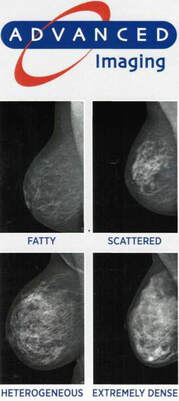
WHAT IS DENSE BREAST TISSUE? Breast tissue is made up of two types: fatty (non-dense) tissue and fibroglandular (dense) tissue. HOW DO I KNOW IF I HAVE DENSE BREAST TISSUE? Have a mammogram. The radiologist can determine your breast density by looking at these X-rays of the breasts. A grading scale is used to break density levels into four groups, ranging from "almost entirely fatty" to "extremely dense tissue present." Your doctor can explain your results to you. WHAT IF I HAVE DENSE BREAST TISSUE? Talk with your doctor about your risk factors for breast cancer, such as breast density, age, family history and your own health history. You and your doctor may decide that you would benefit from more screening tests. One option is 3D mammography, which has shown to be more effective in finding cancer in dense breasts. WHY HAVEN'T I HEARD OF BREAST DENSITY BEFORE NOW? A few years ago a state law went into effect requiring patients be notified of their breast density. This is intended to make women aware that if they have dense breasts, they may benefit from additional screening. Frequently Asked Questions About 3D Mammography WHAT IS A 3D MAMMOGRAPHY BREAST EXAM? A 3D mammogram is a new screening and diagnostic tool to help with early breast cancer detection. It is done at the same time as a traditional 2D mammogram. During the 3D part of the exam, the X-ray arm sweeps in a slight arc over your breast, taking multiple images. Then, a computer makes a 3D image of your breast tissue in one millimeter slices. This allows the radiologist to better see breast detail. A 3D mammogram can be especially helpful for those with dense breasts. WHY IS THERE A NEED FOR 3D MAMMOGRAPHY BREAST EXAMS? WHAT ARE THE BENEFITS? With regular 2D mammography, the radiologist views your breast tissue in one flat image. Sometimes breast tissue can overlap, giving the illusion of normal breast tissue looking like an abnormal area. By also looking at the breast tissue in one millimeter slices, the radiologist can provide a more accurate exam. In this way, 3D mammography finds 25-40% more invasive cancer that may be missed with regular 2D mammography. It also means there is less chance you would be called back later for a "second look," because now the breast tissue is seen more clearly. WHAT SHOULD I EXPECT DURING THE 3D MAMMOGRAPHY EXAM? A 3D mammogram is done at the same time as your 2D mammogram. The 3D portion only takes a few more seconds. There is no additional compression of the breast. IS THERE MORE RADIATION DOSE? Very low X-ray energy is used during the exam. It is about the same amount as a regular mammogram done on film. Methodist Center for Diagnostic Imaging centers are operated by Methodist GDI, a Texas non-profit corporation, and are staffed by independently practicing physicians who are contracted by Methodist GDI. The physicians and staff who provide services at the imaging centers are not employees or agents of Methodist Health System or any of its affiliated hospitals. © 2016, Center for Diagnostic Imaging 02162016 |

- Home
- President
- Executive Vice President
- Secretary/Treasurer
- Clerk Craft
- Maint. Craft
- Health Plan Director
- Officers
- BMC/NDC Corner
- News from Editor
- Retirees
- Pictures
- Article 12 Questions and Answers
- News and Event
- Downloads
- Elected Officers & Delegates
- Political Issues
- Member Advertisements
- Workplace Harassment
- eOPF Access
- Election Re-run 2025
